
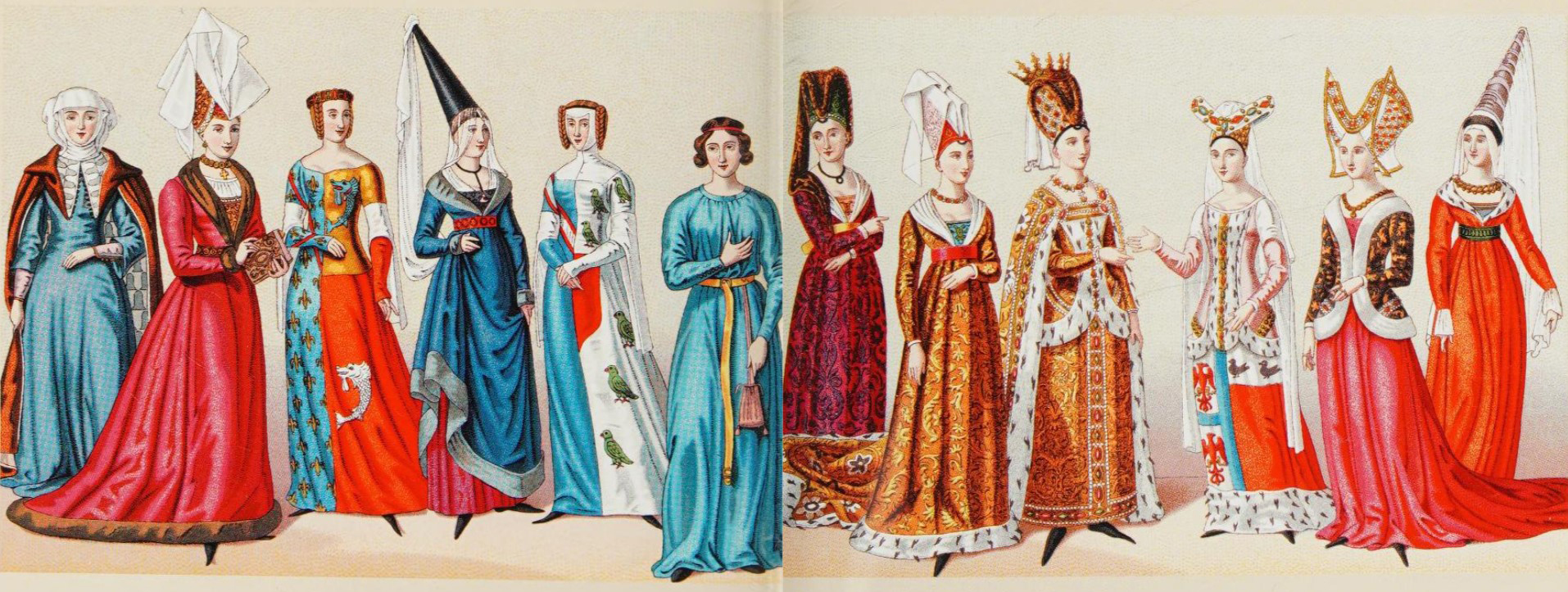
Medieval Europe: Late Middle Ages Fashion and Attire
The Late Middle Ages, spanning the 14th to the 15th century, was a period of dramatic social, political, and economic transformations which were intricately reflected in the fashion trends of the time. This era, marked by the Black Death, the Hundred Years’ War, and the early Renaissance, saw a distinct evolution in clothing styles that emphasized more tailored and luxurious garments.
Sumputary laws particularly under the reigns of Edward III and Elizabeth I, were still in place. Edward III’s laws were primarily aimed at curbing the extravagant spending of the nobility and the burgeoning middle class that was beginning to rival the aristocracy in wealth and appearance. Elizabeth I’s regulations, detailed in the “Statutes of Apparel” issued in 1574, were more comprehensive, specifying colors, fabrics, and styles that different classes could wear, ostensibly to maintain the social order and reduce spending on foreign textiles.
Materials and Craftsmanship:
Clothing during the Late Middle Ages was crafted from a variety of materials, with wool and linen still being predominant for the majority of the population. However, the growing wealth and influence of the urban bourgeoisie and the continued splendor of the nobility introduced more luxurious fabrics into fashion, such as silk, velvet, and fine furs, often imported from other parts of the world. The use of vibrant dyes and intricate embroidery became more common, showcasing the wearer’s wealth and status.
Everyday Wear:
The 1300s saw a major change in clothing, especially for men. In the early decades In the early 1300s, the upper class or nobility would wear a suit of robes consisting of three or four garments, line undergarments, a tunic, supertunic, a hood and a mantle.
From the mid-century onward was the rise of the doublet, a snug-fitting buttoned jacket that often extended to the upper thighs and was sometimes worn beneath a shorter over-garment or surcoat. Hose, which covered the legs, became more form-fitting and were often brightly colored. Women wore long gowns with tight-fitting bodices and full skirts. Sleeves became an important fashion feature, with styles like the hanging sleeve adding a sense of drama and luxury to women’s attire.

Military and Chivalric Attire:
As armor technology evolved, so did the garments worn with it. The surcoat gave way to the jupon, a shorter, padded garment that was often embroidered with heraldic symbols. Plate armor became more widespread, influencing the military silhouette and requiring undergarments like the arming doublet to ensure comfort and proper fit.

Clerical and Monastic Clothing:
Clergy attire remained relatively conservative, emphasizing modesty and uniformity. However, higher-ranking officials in the Church might wear more ornate versions of liturgical garments, often adorned with gold thread and fine jewels, reflecting both their religious role and social status.
Symbolic and Functional Elements:
The Late Middle Ages saw a continuation of the use of clothing as a marker of social status and identity. Sumptuary laws became more specific, controlling not only the types of fabrics and colors worn by different classes but also items such as fur trimmings and the length of trains on gowns.
Legacy and Influence:
The fashion of the Late Middle Ages paved the way for the sartorial splendor of the Renaissance. The period’s emphasis on form-fitting garments and rich ornamentation carried over into the next centuries, influencing the luxurious court fashions of early modern Europe.
The attire from the Late Middle Ages reflects a society in transition, increasingly influenced by visual display and personal aesthetics. It provides a rich tapestry of historical information, revealing the complexities of medieval life and the interplay between fashion, social order, and cultural expression during a time of profound change.