
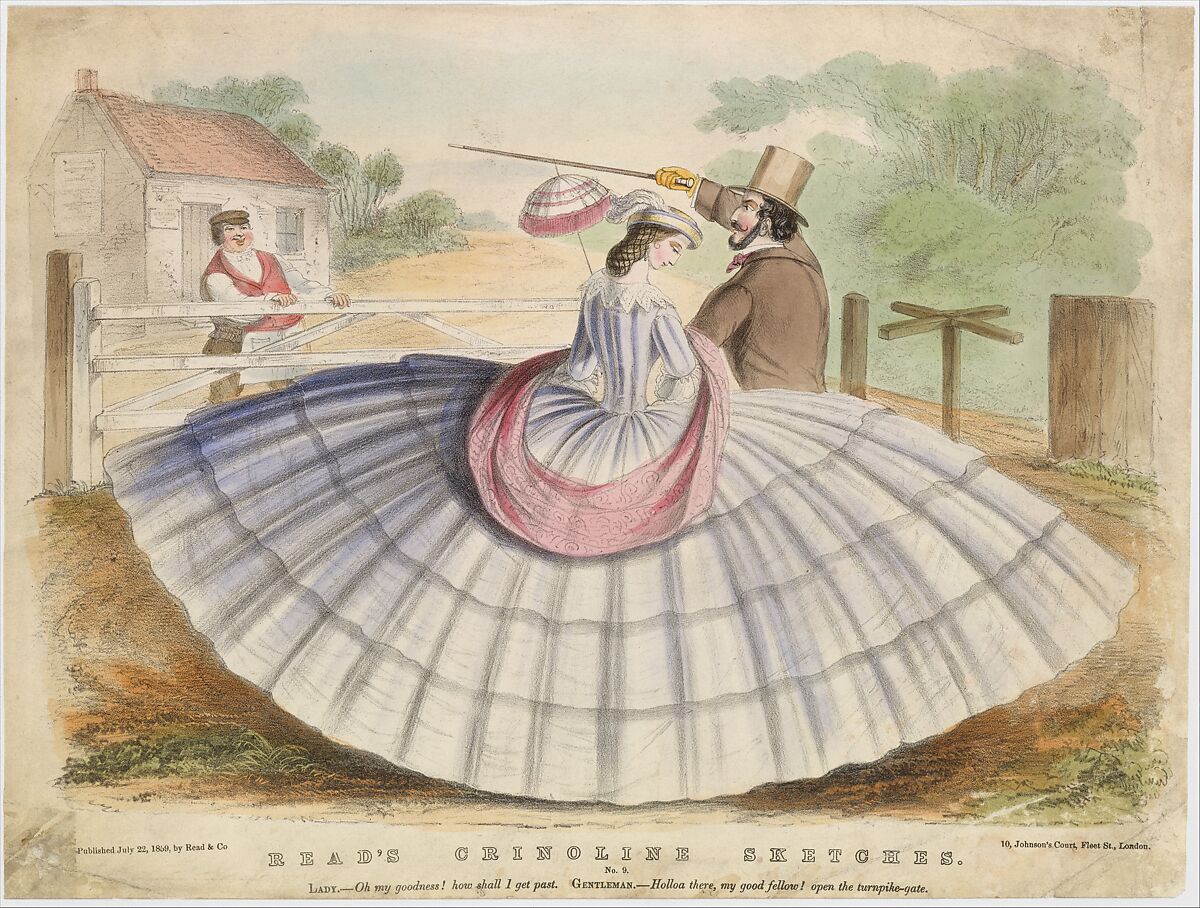
The crinoline, a key fashion feature of the mid-19th century, dramatically reshaped women’s fashion with its wide, bell-shaped silhouette. This distinctive style became popular in the 1850s and remained in fashion until the late 1860s, reflecting the Victorian era’s notions of beauty, status, and femininity.
Development and Design:
Originally, crinolines were constructed from stiff fabrics like horsehair and linen (the word ‘crinoline’ derives from the French words ‘crin’ meaning horsehair and ‘lin’ meaning linen). However, the invention of the steel hoop crinoline in the 1850s revolutionized its design. It was first patented in April 1856 by R.C. Milliet in Paris, and t became extremely popular. and steel cage crinolines were mass-produced in huge quantity, with factories across the Western world producing tens of thousands in a year.

Empress Elizabth (Sisi) of Austria in a white satin evening dress covered with thousands of silver foil stars shimmering under the layer of tulle,thought to be designed by the House of Worth.
The crinoline was much lighter than the previous fashion of multiple petticoats, as it reduced the number of hampering petticoats, and increased freedom of movement.
This new crinoline was made of a series of concentric steel hoops that were lightweight, more flexible, and less cumbersome than fabric crinolines. The steel hoops were attached to fabric tapes and covered with a skirt, allowing dresses to expand horizontally while remaining relatively comfortable and manageable.

Cultural Significance:
The crinoline was more than a fashion statement; it was a marker of social status and an embodiment of the ideal Victorian woman — demure and domestically centered, yet visually commanding. The wide skirts required careful navigation through doors and furniture, a constant reminder of the wearer’s genteel nature. Despite its impracticality, the crinoline underscored the era’s values and the importance placed on appearances.
Practical Implications and Adaptations:
While crinolines allowed for dramatic silhouettes and elaborate ornamentation on skirts, they were not without practical challenges. They could be hazardous near open flames or machinery and cumbersome in crowded spaces. As a result, crinolines were often ridiculed in contemporary satire and criticized for their impracticality. Nonetheless, they were adapted in various ways, becoming lighter and more flexible over time to address practical concerns while still maintaining the desired silhouette.
At its widest point, the crinoline could reach a circumference of up to six yards, although by the late 1860s, crinolines were beginning to reduce in size.
Decline and Legacy:
By the late 1860s, the crinoline began to fall out of favor, giving way to the bustle, which provided emphasis at the back of the skirt rather than around the entire circumference. The shift away from crinolines reflected changes in social attitudes, including movements towards more rational dress and women’s increasing participation in public life.

The crinoline began falling out of favour from the late 1860s and the crinolette, was a transitional garment bridging the gap between the cage crinoline and the bustle.
The crinoline era is a vivid chapter in fashion history that offers insight into the social dynamics, technological advancements, and cultural values of the Victorian period. Its rise and decline illustrate the constant interplay between fashion innovation and practicality, leaving a lasting impact on the development of women’s wear.