
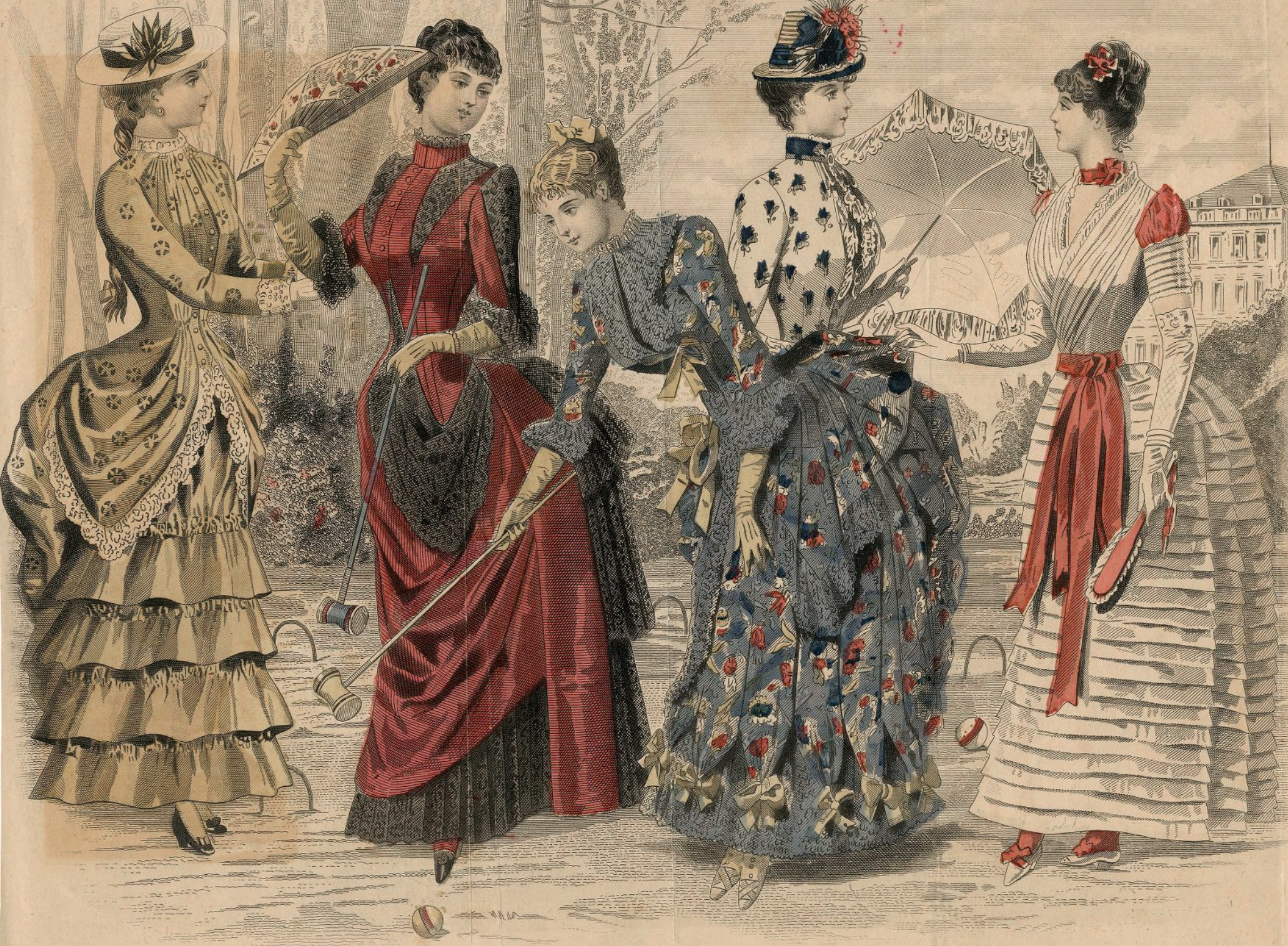
In the late 1860s, the crinoline, which had dominated women’s fashion with its wide, hoop-supported skirts began to fall out of favor. The silhouette shifted towards the rear of the dress, culminating in the development of the bustle in the early 1870s. The bustle was a framework or padding attached at the back of the waist to support the drapery of the dress, creating a pronounced back profile that emphasized a narrow waist and full hips.
The Bustle’s Evolution: The bustle went through several iterations:
- Early Bustle (1870-1878): During its initial phase, the bustle created a more subtle fullness at the back of the skirt. Dresses often featured elaborate trims, ruching, and layers of fabric that accentuated the rear silhouette. Around 1874, the style altered and the skirts began to hug the thighs in the front while the bustle at the back was reduced to a natural flow from the waist to the train.

- Natural Form Era (1878-1882): A brief period where fashion shifted towards a slimmer profile, with less emphasis on rear padding. Skirts were more fitted, and the overall silhouette was elongated and more restrained.

- Second Bustle Period (1883-1890): The bustle returned with greater emphasis, creating a more exaggerated back profile than its earlier version. The late bustle era saw the peak of this style, with the rear of the dress often adorned with bows, pleats, and ruffles. The bustle was at its greatest extension by 1885. It was almost perpendicular to the back and heavily upholstered. The 1880s versions were as padded and heavily embellished as a drawing-room hassock of the period. It was a popular conceit that the cantilevers of these bustles could support an entire tea service. To sustain the greater weight of the 1880s gowns, light and flexible infrastructures were created with flexible materials–wire, cane, whalebone–held together by canvas tapes or inserted into quilted channels.

1890 Legacy and Decline: By the early 1890s, the bustle began to fade from fashion, paving the way for the softer, straighter silhouettes of the Edwardian era. The shift away from the bustle reflected broader changes in women’s social positions and the beginnings of movements toward more practical and less restrictive clothing.