
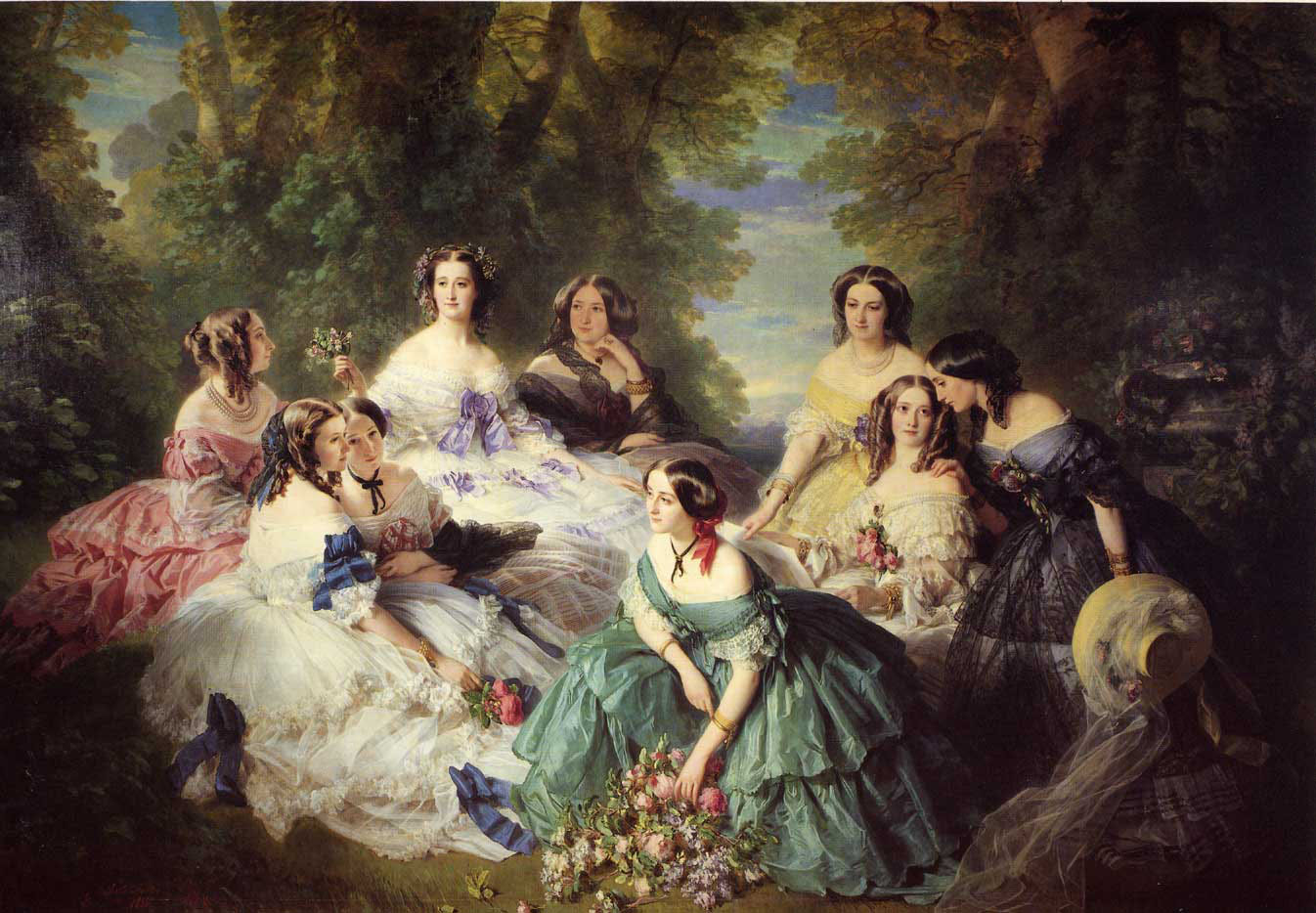
The transition from the Regency era to the Victorian era in the 19th century marked significant changes in fashion that mirrored broader societal shifts and technological advancements. As the century progressed, the silhouettes, fabrics, and cultural meanings imbued in clothing evolved dramatically, reflecting the changing attitudes of the time towards social status, gender roles, and industrial progress.
Transition Period (1820s-1830s):
The transition from the Regency era to the Romantic era in the 1820s marked a significant shift in women’s fashion, reflecting broader cultural changes. Moving away from the Empire style’s neoclassical simplicity and high waistlines, fashion embraced the Romantic Movement’s emphasis on emotion, individualism, and a fascination with the past. This period saw an increasing influence of Gothic elements and a revival of historical styles inspired by the popular literature of the time, such as the works of Sir Walter Scott.
Romantic fashion rejected the clean lines and monochromatic palette of earlier styles, instead adopting exuberant layers of colorful patterns and fuller, curvaceous shapes. The silhouette evolved significantly; while the decade began with high waistlines and slightly flared skirts, by 1825, waistlines had descended to nearly natural levels, skirts expanded with additional gores, and sleeves became dramatically puffed, fully embodying the early Romantic style. This era’s fashion was not just about aesthetic changes but also echoed the period’s deep engagement with artistic and historical themes, drawing direct inspiration from the era’s leading cultural figures and their romanticized visions of the past.

As women’s fashion transitioned back to natural waistlines in the late 1820s, the importance of corsetry increased to accentuate a slender waist. Corsets became tightly laced, longer, and incorporated gussets to emphasize the hips and breasts, enhancing the body’s natural curves. Alongside these, wide waistbands and decorative belts were used to highlight the fashionably nipped waist. The silhouette changes also affected other undergarments: supportive petticoats were essential, and small bustles, often down-filled pads, provided additional shape to the skirts. Furthermore, as sleeves grew larger, sleeve supporters—down-filled pads tied around the arm and attached to the corset—became necessary to maintain the dramatic sleeve shapes that characterized the period’s fashion.
1830s

During the early 1830s, fashion emphasized a nipped waist situated just above the natural waistline, creating a short-waisted effect, accompanied by wide sleeves and skirts that ended just above the ankle. This silhouette highlighted an overall expansive width, with the sleeve becoming the standout fashion element. Gigot or leg-o-mutton sleeves were especially prominent, reaching their largest size between 1830 and 1833. These sleeves varied in design, from the standard gigot that was full to the wrist, to the demi-gigot which fitted from the elbow, and the whimsical “à la giraffe” style, marked by puff sections created by banded fullness.
By 1836, the trend towards increasingly voluminous sleeves reached its peak and abruptly shifted. Women’s fashion adopted a drooping, more sentimental style as the decade progressed, with waistlines and hemlines lengthening. Sleeve design moved away away from the voluminous gigot to a more tightly fitted style. The fullness in sleeves began to migrate towards the lower arm, while various treatments like gathering or pleating were applied to manage the fullness at the upper arm, leading to the evolution of the dropped gigot sleeve.

Headwear and Hairstyles
During the 1830s, hair and headgear styles in fashion exhibited a diverse and bold range of forms. Hairstyles featured high chignons made of loops, braids, or curls, with the front often styled into rows of sausage curls or ringlets. Popular styles included the Apollo knot and the hairstyle à la Chinoise. Indoors, married women typically wore white, frilled day caps. Outdoors, both hats and bonnets had expanded considerably in width by 1830 to counterbalance the wide sleeves, but they began to decrease in size later in the decade.

The headgear of the era featured high crowns and large, halo-like brims, heavily adorned with trim. However, by 1836, as the fashion silhouette changed, so did the styles of hair and headgear. Hairstyles became simpler, with hair usually parted in the center, smoothed over the ears, and gathered into a chignon at the back. The brims of hats and bonnets narrowed and shifted downward, changing from a face-framing to a more concealing shape.
Evening hairstyles remained more elaborate, often decorated with combs, feathers, ribbons, and flowers. For evening wear, married women frequently chose heavily trimmed turbans, reflecting the period’s continued penchant for ornamental detail despite the trend towards simpler daytime styles.

Men’s fashion
Men’s fashion saw less dramatic changes but still evolved to include more specific outfits for different occasions—morning coats, frock coats, and evening tails. The introduction of the sack suit in the late Victorian period also signaled a move towards slightly more relaxed styles that would eventually lead into 20th-century men’s fashion.
The Early Victoria Era – the demure 1840s
The 1840s were the last years of the Romantic Era (Tortora 328), but the exuberant buoyancy of the Romanticism that marked womenswear in the 1820s and 1830s had developed into a drooping, subdued style more associated with the Gothic Revival
In 1837 Queen Victoria’s reigh began in England ushering in a more demure era of fashion.
1840s Fashion: A Decade of Transition and Refinement
Overview of the 1840s:
The 1840s marked a distinctive period in fashion history as styles transitioned from the romantic flamboyance of the 1830s to a more subdued and structured aesthetic. This decade was characterized by changes in silhouettes, fabrics, and societal attitudes that reflected the growing influence of the Industrial Revolution and shifting social dynamics.
Women’s Fashion:
The silhouette of women’s fashion in the 1840s showed a notable evolution. Early in the decade, the broad shoulders and voluminous sleeves of the previous era gave way to a more demure and elongated look. Dresses featured a lowered shoulder seam and fitted bodices that emphasized a narrow waist, achieved through corseting. Skirts were full but less expansive than in the 1830s, often supported by layers of petticoats rather than crinolines, which had not yet come into widespread use.
Sleeves initially remained large but gradually became more streamlined, transitioning into the ‘bishop’ and ‘pagoda’ styles that became tighter at the shoulder and flared towards the wrist. Necklines were predominantly high and round for daywear, with lace or linen collars providing modest decoration. For evening wear, lower necklines such as the off-the-shoulder style were popular, often accompanied by short sleeves.
Men’s Fashion:
Men’s fashion in the 1840s continued the trend towards greater simplicity and sobriety that had begun in the previous decade. The frock coat became increasingly popular and was worn in various lengths, with a cutaway front that allowed the waistcoat beneath to be seen. Trousers replaced knee breeches almost entirely in all but the most formal of settings. Waistcoats were often elaborately decorated compared to the relatively somber colors of coats and trousers. Shirts typically had high, stiff collars, and cravats or neckties were essential accessories that added a touch of personal style.
Materials and Techniques:
The 1840s saw significant advancements in textile production due to the Industrial Revolution. This led to a wider availability of materials like cotton and cheaper wool, which became increasingly used in everyday garments. However, silk and fine wools were still preferred for higher-end and formal garments. Print designs included florals, plaids, and stripes, which were popular for both men’s waistcoats and women’s dresses.
Cultural Influence:
Fashion in the 1840s was influenced by a growing middle class and the ideals of practicality and propriety. The era’s styles reflect a society in transition, grappling with new industrial capabilities and the social changes they wrought. The decade’s fashion was practical yet elegant, mirroring the Victorian virtues of restraint, moral conduct, and a clear delineation between public and private life.
Conclusion:
The 1840s were a decade of understated elegance and increasing accessibility in fashion, setting the stage for the more dramatic styles of the mid-to-late Victorian era. The clothing of this period offers a window into a society on the cusp of modernity, where fashion was both a reflection and an agent of broader cultural shifts.